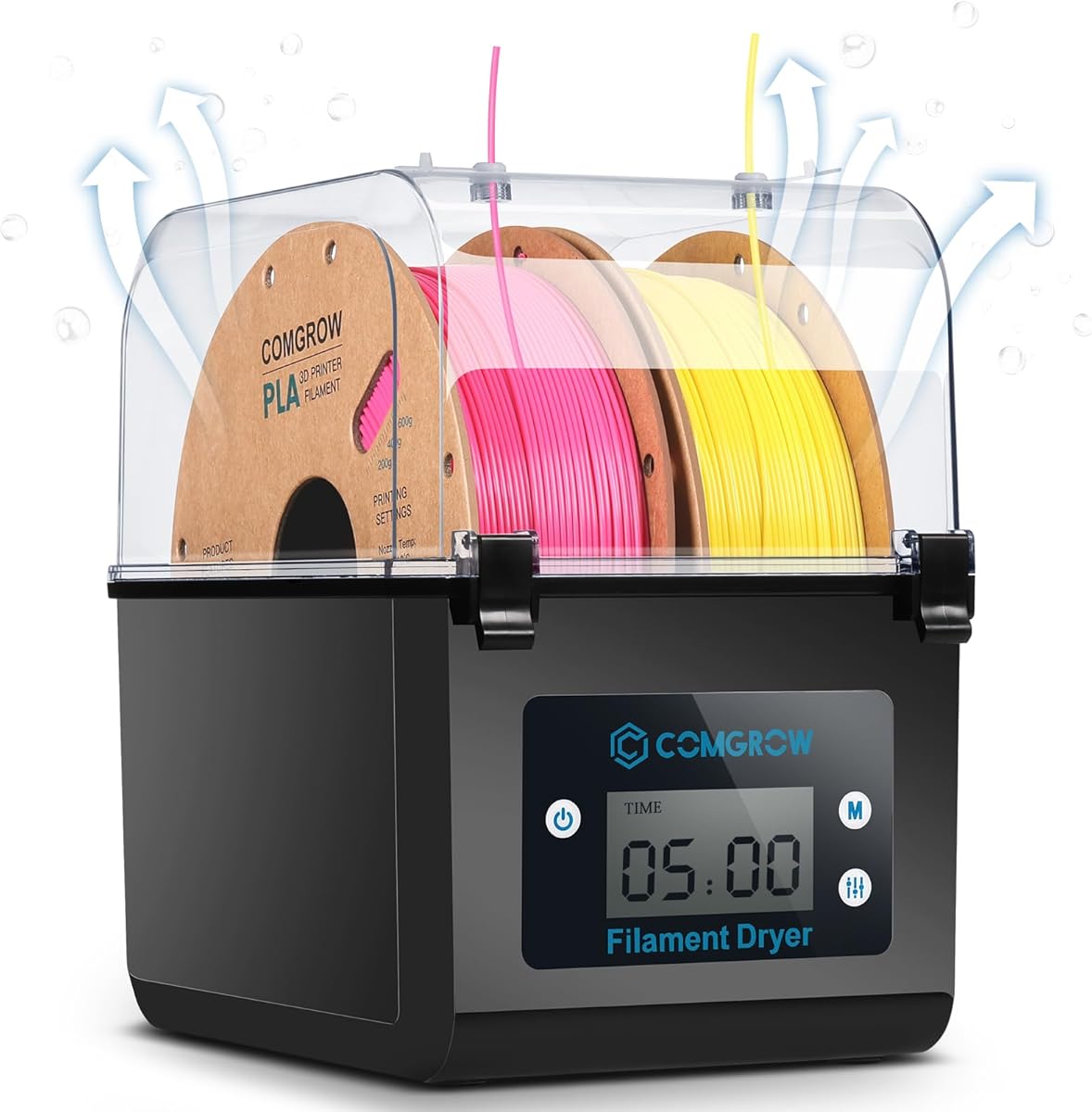
Comgrow 3D Printer Filament Dryer Box
4.4Editor score
Affordable entry level price point
LCD touch screen interface
Stores two 1kg spools
This guide compares the top filament dryer for 3D printing models to help you choose the best moisture control solution for your specific printing needs.
Filament dryers are essential tools for any serious 3D printing enthusiast looking to improve print quality and reduce failure rates caused by moisture absorption in hygroscopic materials.
We compared ten leading filament dryer models based on heating technology, capacity, user interface, and compatibility to provide a comprehensive overview of the current market options available now.
Each pick highlights unique strengths and trade-offs to help you decide quickly, though you should verify current availability and pricing on the manufacturer or retailer websites before purchasing.
4.4Editor score

4.6Editor score

4.5Editor score
The following table provides a side-by-side comparison of key specifications for all ten models reviewed in this guide to help you identify the right fit for your setup.



The Creality Space Pi X4 stands out as the top choice for high volume users needing reliable moisture control across multiple filament types and sizes.
We may earn a commission when you buy through this link, at no additional cost to you.
Its dual independent heating chambers allow for faster drying cycles compared to single chamber units while the touch interface provides intuitive control over complex settings.
While the price is higher than entry level models the improved efficiency and capacity justify the investment for those printing regularly with hygroscopic materials.
This model is best suited for advanced makers who need to dry large batches quickly and want to store spools in a controlled environment between prints.
The dual heating system removes moisture 30 percent faster than standard single chamber dryers ensuring your filaments are print ready in hours not days.
Beyond drying it maintains low humidity during storage periods preventing re absorption of moisture when printing pauses or between jobs.
We may earn a commission when you buy through this link, at no additional cost to you.
The Comgrow filament dryer offers an accessible entry point into active drying with a focus on simplicity and essential features for casual printers.
We may earn a commission when you buy through this link, at no additional cost to you.
Its large storage volume fits two standard spools and the LCD screen makes it easy to monitor temperature and humidity without complex controls.
While it lacks the high heat needed for engineering filaments it performs well for PLA PETG and ABS which are common in hobbyist printing.
This unit is ideal for beginners or those on a budget who want to improve print quality without investing in expensive advanced systems.
The touch buttons and clear display simplify the setup process allowing users to start drying immediately with minimal instruction or technical knowledge.
A silicone cable sheath and snap button cover structure ensure the chamber stays sealed to prevent moisture from entering during operation.
We may earn a commission when you buy through this link, at no additional cost to you.
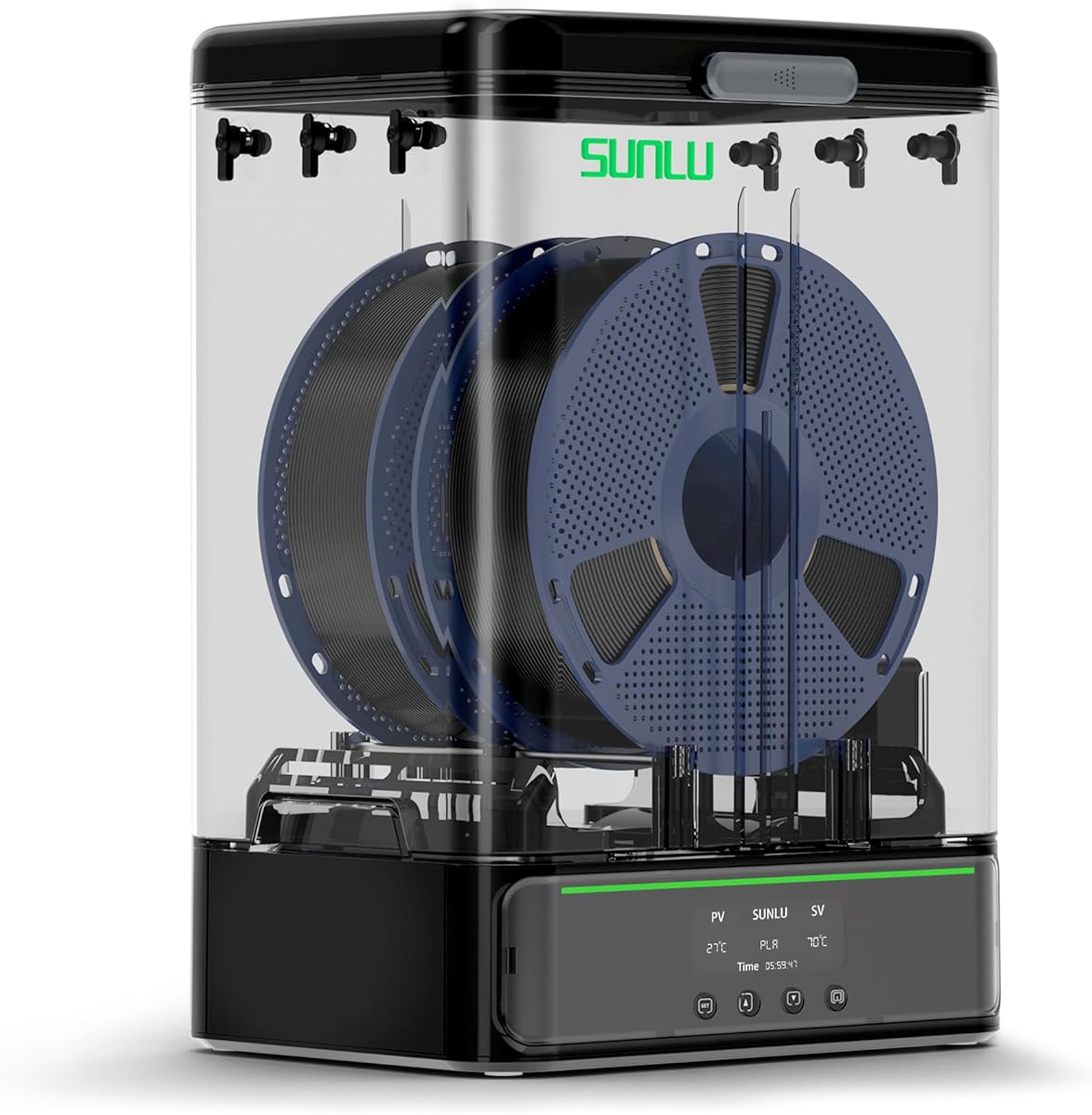
The SUNLU S4 is a robust industrial style dryer designed for users who need to manage multiple spools and printers simultaneously with consistent heat distribution.
We may earn a commission when you buy through this link, at no additional cost to you.
Its 350W heater and three circulation fans ensure even drying across the entire chamber while the eight exit holes allow for complex multi printer setups.
The weight and size are significant but they contribute to the stability and thermal mass required for maintaining steady temperatures during long drying cycles.
This dryer is best for professional workshops or serious enthusiasts who need maximum capacity and flexibility in how they feed filament to printers.
The high wattage heater provides 50 percent more efficiency than previous models ensuring quick warm up times and stable operating temperatures.
With eight exit points you can run filament to multiple machines or different angles without tangling or stress on the filament spool.
We may earn a commission when you buy through this link, at no additional cost to you.
The SUNLU S1 Plus introduces a fan design to accelerate moisture removal making it a solid choice for those needing quicker drying times in smaller units.
We may earn a commission when you buy through this link, at no additional cost to you.
Its visual display tracks temperature time and humidity accurately allowing for precise adjustments that suit different filament requirements and environmental conditions.
While the capacity is limited to two spools the efficiency gains from the fan make it competitive against static heating units with similar sizes.
This model is recommended for users who want better drying speed than basic models without jumping to larger more expensive multi spool systems.
The added fan design speeds up the discharge of excess water from filaments reducing the impact of wet weather on print quality.
Adjustable settings let you tailor the drying process to specific materials ensuring optimal results without risking heat damage to sensitive filaments.
We may earn a commission when you buy through this link, at no additional cost to you.
The Creality Space PI Plus balances cost and features with a large touch screen and preset options that simplify operation for a wide variety of materials.
We may earn a commission when you buy through this link, at no additional cost to you.
Its 360 degree hot air circulation ensures even drying while the twelve filament presets remove the guesswork from setting temperatures for new materials.
The extended timer function allows for long unattended drying sessions which is useful for restoring damp filaments without constant supervision.
This unit is ideal for intermediate users who want advanced features like presets and large displays without the bulk and cost of enterprise level dryers.
The large touch screen supports switching between Celsius and Fahrenheit making it accessible for users in different regions who need quick access to settings.
The PTC heater provides uniform drying compared to heating pads ensuring your filament gets consistent heat throughout the entire spool volume.
We may earn a commission when you buy through this link, at no additional cost to you.
The Polymaker Polydryer offers a connected drying and storage solution that minimizes exposure to ambient moisture by allowing direct feeding from the sealed box.
We may earn a commission when you buy through this link, at no additional cost to you.
Its built-in hygrometer makes it easier to track conditions without guesswork ensuring you know exactly when your filament is ready to print with.
While it handles one spool at a time the integrated approach to drying and storage makes it a compact and reliable choice for single printer setups.
This unit is best for users who prioritize moisture defense between prints and want a streamlined workflow from drying to feeding without transfer.
The combined approach of heated drying sealed storage and desiccant support provides ongoing protection that keeps filaments dry over longer periods.
Move from drying to printing without breaking the seal which helps lock in dry conditions between jobs and maintains filament quality.
We may earn a commission when you buy through this link, at no additional cost to you.
The Creality Space PI SE offers a compact and efficient drying solution with PTC heating that ensures even heat distribution across the chamber.
We may earn a commission when you buy through this link, at no additional cost to you.
Its real-time humidity monitoring and simple knob interface make it straightforward to use for maintaining dry conditions during storage and printing.
The insulation keeps heat in and protects against scalding while the design allows for easy operation without complex menus or setup steps.
This dryer is suited for small setups where space is limited but quality drying performance is still essential for consistent print results.
The PTC solution heats the chamber quickly and evenly reducing wait times before you can start drying your filaments for upcoming jobs.
Thermal insulation cotton on the walls keeps the unit warm internally while preventing the exterior from getting too hot to touch safely.
We may earn a commission when you buy through this link, at no additional cost to you.
This SUNLU S4 variant provides high capacity with a robust heating system that ensures consistent temperatures across a large volume of filament.
We may earn a commission when you buy through this link, at no additional cost to you.
The combination of a powerful heater and multiple fans ensures even drying throughout the chamber while the large size allows for bulk storage and drying.
Its customization options allow for modification to accommodate larger spools or alternative uses which adds versatility beyond standard drying tasks.
This dryer is ideal for power users who need to keep multiple spools ready and appreciate the flexibility to adapt the unit to unique needs.
Three circulation fans work with the heater to ensure consistent temperature across the entire area for more even drying results.
Detailed video instructions are available to modify the unit for drying larger rolls or other purposes expanding its utility beyond standard use.
We may earn a commission when you buy through this link, at no additional cost to you.
The SUNLU SP2 is designed specifically to accommodate larger 3kg spools which is a rare feature among consumer level filament dryers on the market.
We may earn a commission when you buy through this link, at no additional cost to you.
Its detachable base allows it to function as a standalone storage box after drying ensuring your filament remains dry even when not actively in use.
The 250W PTC heater reaches 70 degrees quickly and maintains steady temperature for efficient drying cycles that preserve filament integrity.
This model is best for industrial or high volume users who rely on large spools and need a dedicated solution for keeping them dry during storage.
The box comes with rollers and holders that support spools up to 3kg making it perfect for those buying in bulk to reduce costs.
Included hygrometer and desiccant containers provide real-time interior humidity data so you can manage conditions without guesswork.
We may earn a commission when you buy through this link, at no additional cost to you.
The SUNLU S2 is a user-friendly entry level dryer that simplifies the process of drying filament with straightforward touch controls and visual feedback.
We may earn a commission when you buy through this link, at no additional cost to you.
Its internal spindle ensures the filament spins continuously for even exposure to heat which helps avoid hot spots that might damage sensitive materials.
The translucent lid allows you to check on your filament without opening the unit maintaining the dry environment while you monitor progress.
This unit is ideal for beginners who want to improve print quality without dealing with complex settings or advanced technical configurations.
The built-in spindle rotates filament continuously during the drying process ensuring uniform moisture removal from the entire spool.
A translucent lid enables users to check on the filament without opening the lid to preserve the dry environment inside.
We may earn a commission when you buy through this link, at no additional cost to you.
Selecting the right filament dryer requires understanding your specific needs regarding capacity heating speed and material compatibility.
Consider how many spools you need to store or dry simultaneously as units range from single spool holders to systems that accommodate four or more 1kg spools or larger rolls. Larger units often take up more desk space but provide greater efficiency for frequent printing.
Choose a capacity that matches your workflow volume so you do not buy too little or too much hardware than your daily needs.
PTC heaters are generally more efficient and safer than traditional heating pads or coils as they regulate heat internally and warm up quickly without overshooting set temperatures. Some models also include fans to circulate hot air which speeds up drying and prevents uneven heating inside the chamber.
Look for models with good thermal regulation to avoid damaging heat sensitive filaments like TPU while still reaching high enough temperatures for engineering plastics.
Most common filaments like PLA PETG and ABS require lower temperatures around 45 to 60 degrees while materials like Nylon PC or ABS might need up to 80 degrees or higher for effective drying. Ensure the maximum temperature of the unit meets the requirements of the most demanding filament you plan to use.
A wide adjustable range gives you flexibility to experiment with different materials and restore damp old filament effectively.
Interfaces vary from simple knobs to digital touch screens that show real-time humidity and temperature data. Advanced units offer presets for different filament types which simplify setup and reduce the risk of human error when selecting parameters.
Choose a control method that feels intuitive to you so you can adjust settings quickly and monitor drying progress without distraction.
Effective sealing prevents ambient humidity from re-entering the chamber during printing or storage which is as important as the heating function itself. Look for silicone gaskets or robust latch systems that create an airtight environment to keep your filaments dry over longer periods.
Models that double as storage boxes help maintain the dry environment between jobs reducing the need to reseal bags manually every time.
The design of the outlet holes affects how smoothly filament feeds into your printer without tangling or friction. Some models offer multiple exit angles or holes allowing you to feed multiple printers from one dryer or choose the best orientation for your printer's extruder.
Check for included PTFE tubing and clamps as these accessories help guide the filament and reduce drag during printing.
Established brands often provide better build quality and customer support which can be critical if you encounter technical issues with electronics or heating elements. Reading reviews and checking warranty terms can give you confidence in the longevity of the product you are purchasing.
Prioritize brands with a track record of quality in the 3D printing ecosystem to ensure you get a reliable drying system.
Prices vary widely from budget friendly entry models to expensive industrial units so determine your spending limit based on how much you print and how critical print quality is to you. Sometimes a slightly higher upfront cost pays off in better efficiency and longevity over time.
Evaluate the features you actually need versus what is nice to have to find the best value within your price range.
To begin using your filament dryer place the spool on the holder inside the chamber and thread the filament through the outlet tube so it feeds smoothly into your printer if you plan to print while drying.
Set the temperature and timer according to your filament type ensuring the heat is high enough to remove moisture but low enough to avoid deforming the material and wait for the drying cycle to complete.
After drying close the sealing hole and store the filament in the unit or a sealed bag to prevent moisture re-absorption and clean the outlet tubes periodically to ensure smooth feeding and avoid clogs.
Drying filament removes moisture that can cause bubbling stringing and poor layer adhesion during printing. Without drying hygroscopic materials absorb water from the air which leads to print failures and compromised mechanical properties.
Drying time varies by material and moisture level but typically ranges from four to twelve hours. Some units allow setting longer times up to forty eight hours for heavily damp filaments to ensure thorough drying.
Yes if the unit supports it but you should ensure the temperature settings are safe for all materials in the chamber. Using preset modes or setting a compromise temperature helps avoid damaging sensitive filaments.
A dryer actively removes moisture using heat while a storage box passively protects filament from ambient humidity. Some units combine both functions allowing you to dry and then store filament in the same sealed enclosure.
Most consumer filament dryers consume moderate power similar to small household appliances. The heating element and fans operate intermittently so overall energy usage is generally low compared to the 3D printer itself.
You can monitor humidity levels using units with built-in hygrometers or observe print quality improvements. If stringing and bubbling decrease significantly the filament is likely dry enough for printing.
Yes you can use an oven with careful temperature control but this carries a higher risk of melting or damaging the filament. Dedicated dryers provide safer and more consistent results for regular use.
Materials like Nylon TPU PC and PETG are highly hygroscopic and benefit the most from drying. PLA also benefits particularly if it has been exposed to high humidity or stored for long periods.
We have reviewed ten top filament dryers ranging from budget models to high-capacity systems so you can find the right balance of features and cost for your setup.
Consider capacity heating efficiency and control interface when making your decision as these factors directly impact how well your prints turn out and how much time you spend maintaining your filament.
Prices and availability change frequently so check the latest listings on manufacturer or retailer sites before purchasing to ensure you get the best deal on your chosen model.