
Sntieecr STEM Electric Circuit Motor Kit, Science Experiment Educational Kit
4.2Editor score
Complete circuit motor components
Includes motors and propellers
Ideal for school science projects
This guide compares the top electricity learning kits for students and hobbyists, evaluating components, safety, and educational value to find the best options.
Electricity learning kits provide an engaging way for students to explore the fundamentals of electrical engineering and physics through hands-on experimentation and practical application.
We evaluated ten top-rated kits based on component quality, instructional clarity, project variety, and safety features to determine which options offer the most educational value for learners.
Each pick highlights unique strengths and target audiences, ensuring you find the right kit for your needs, though availability and pricing may change over time on retailer sites.
4.2Editor score

4.7Editor score

4.5Editor score
The following comparison table provides a side-by-side overview of all ten kits, highlighting their core specifications to help you quickly identify the best fit for your learning goals.



This National Geographic kit stands out as the top choice for young learners due to its extensive library of over 120 electrical projects designed to spark curiosity and engagement.
We may earn a commission when you buy through this link, at no additional cost to you.
The components are designed for safety with snap-on connections that eliminate the need for tools, while QR codes link to video instructions that make setup intuitive for children.
While the price is higher than basic sets, the sheer volume of activities and the quality of the educational materials justify the investment for long-term STEM exploration.
It is ideal for parents and teachers seeking a comprehensive tool that keeps kids occupied for hours while teaching fundamental concepts of circuits and energy safely.
With over 120 projects including light shows and sound systems, this kit ensures continuous learning without repetition.
The snap-on wire system and video guides mean kids can build independently without needing screwdrivers or adult assistance.
We may earn a commission when you buy through this link, at no additional cost to you.
This kit offers a focused approach to learning circuits with eight distinct experiments, including popular fruit battery projects that demonstrate chemical energy conversion effectively.
We may earn a commission when you buy through this link, at no additional cost to you.
It includes a detailed circuit book that guides learners through each step, encouraging critical thinking and problem-solving skills as they build series and parallel circuits.
The limited number of experiments might feel restrictive for advanced users, but the quality of the instruction makes it a strong tool for introducing basic concepts.
It is best suited for teachers or parents looking for an affordable, manageable set that fits well within a school science fair or home lesson plan.
Building a fruit battery allows kids to see how organic materials can power circuits in a tangible and memorable way.
The included circuit book ensures students understand the why behind the experiments, not just the how.
We may earn a commission when you buy through this link, at no additional cost to you.
Targeting grades 9 to 11, this kit dives deeper into physics principles including magnetism and Ohm's law, making it ideal for high school students needing lab prep.
We may earn a commission when you buy through this link, at no additional cost to you.
It includes 56 items for electricity and 21 for magnetism, providing a robust set of components to build complex models like electromagnets and hand crank generators.
The full-color manual explains the underlying principles well, though the complexity may be overwhelming for younger children without adult guidance or prior knowledge.
Educators and high school students will find this kit valuable for reinforcing classroom theory with practical, hands-on experimentation and detailed technical instruction.
The inclusion of magnetism and Ohm's law experiments bridges the gap between basic circuits and real-world physics applications.
Repair tools and a storage bag ensure the kit remains usable and organized through repeated classroom or home lab sessions.
We may earn a commission when you buy through this link, at no additional cost to you.
This kit offers a solid value by combining over 50 experiments with a well-written manual that explains not just the steps but the reasons behind them.
We may earn a commission when you buy through this link, at no additional cost to you.
The solid storage case keeps every item in its fixed place, making it easy to transport to friends or classrooms without losing small components during travel.
Some users might find the manual slightly dense, but the clear illustrations and unique modules like light control LEDs add significant educational depth for learners.
It is a great choice for students who want a complete physics lab experience at home without breaking the budget on premium educational tools.
The manual guides students to discover concepts through experimentation rather than rote memorization.
The fixed-position storage case ensures components are protected and easy to find when setting up experiments anywhere.
We may earn a commission when you buy through this link, at no additional cost to you.
Focused on motors and basic circuits, this kit provides an affordable entry point for kids interested in how electricity creates motion and sound.
We may earn a commission when you buy through this link, at no additional cost to you.
It comes with crocodile clips, bulbs, and multiple motor holders, allowing for versatile experimentation with different configurations and electrical loads easily.
Users must pay attention to voltage and time limits to prevent overheating, but with supervision, it is a safe and engaging tool for learning basics.
This kit is perfect for young learners who want to build simple machines and understand the basics of electromechanical systems without complex tools.
Using propellers and motors helps visualize how electrical energy transforms into kinetic energy.
The complete accessory pack ensures you have everything needed to finish a standard science fair project on time.
We may earn a commission when you buy through this link, at no additional cost to you.
With 50 pieces and a 40-page manual, this kit encourages family science activities that foster critical thinking and observation through guided discovery.
We may earn a commission when you buy through this link, at no additional cost to you.
It includes specific measuring tools like an ampere/voltmeter, which allows kids to see quantitative data alongside their visual experiments for deeper learning.
While the experiments are not highly complex, the focus on parent-child discovery makes it an excellent tool for building scientific curiosity together.
It is ideal for families looking for a safe, educational gift that promotes engagement between parents and children during weekend learning sessions.
Including meters helps kids understand that electricity has measurable properties like voltage and current.
The design encourages adults to participate, turning science into a shared activity rather than a solo task.
We may earn a commission when you buy through this link, at no additional cost to you.
This kit mirrors the EUDAX labs with a focus on solid storage and comprehensive components, offering a double-layer box that keeps items organized and secure.
We may earn a commission when you buy through this link, at no additional cost to you.
The manual guides students through specific content and operation steps, ensuring they understand the equipment required for each experiment before starting work.
Although it is a robust set, the need to prepare batteries separately means you must plan ahead before diving into your first hands-on experiment session.
It is highly recommended for schools or serious hobbyists who need a reliable, portable lab setup that remains organized over years of use.
The double-layer box with fixed positions prevents loss of small parts and ensures easy cleanup after use.
Items like the sensitive ammeter allow for more precise learning experiences than basic toy kits provide.
We may earn a commission when you buy through this link, at no additional cost to you.
As a safe introductory kit, this option helps students consolidate textbook knowledge by building basic series and parallel circuits with English instructions.
We may earn a commission when you buy through this link, at no additional cost to you.
It is particularly well suited for grades 7 through 9 where the goal is to gain a deeper understanding of current basics without overwhelming complexity.
The storage box is practical and compact, though the component variety is limited to essential parts needed for foundational learning and simple experiments.
Teachers and parents looking for a non-intimidating entry point into electronics will find this kit ideal for summer camps or home school units.
The manual aligns well with standard curriculum to help students visualize abstract concepts in textbooks.
The low voltage and simple components ensure a safe experience for younger students just beginning their journey.
We may earn a commission when you buy through this link, at no additional cost to you.
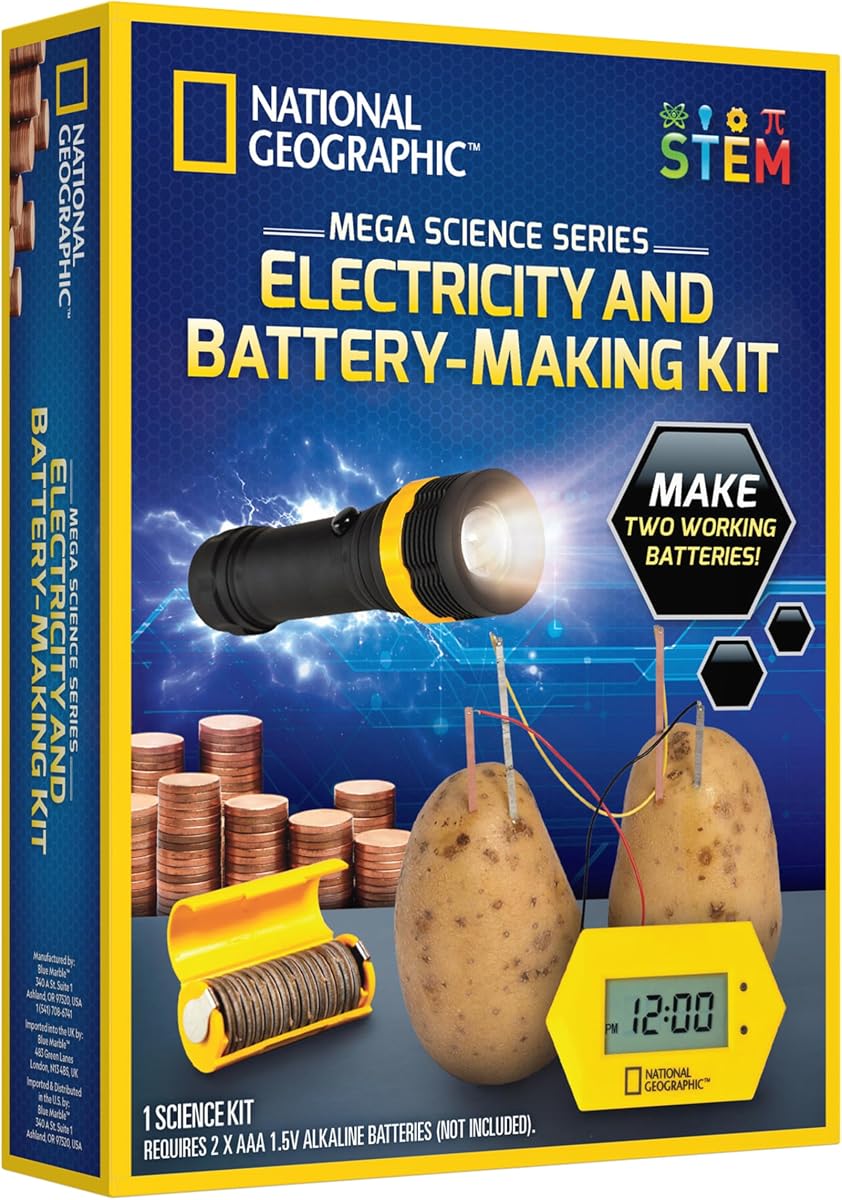
This specialized kit focuses on the chemistry of batteries through two memorable projects that teach how electrical circuits are powered by chemical reactions.
We may earn a commission when you buy through this link, at no additional cost to you.
Kids can build a potato clock and a coin-powered flashlight, using household items to see how electricity is generated and measured with a voltmeter.
While the project count is lower than general circuit kits, the depth of learning about batteries and engineering makes it a unique addition to any collection.
It is perfect for curious kids who want to understand the source of electricity before moving on to complex wiring and components.
The potato and coin experiments highlight the chemical basis of power, making abstract engineering concepts concrete and fun.
Creating a flashlight from coins leaves a lasting impression that helps students remember how voltage and current work.
We may earn a commission when you buy through this link, at no additional cost to you.
This upgrade kit expands on the basic model by including more complex projects like a traffic light circuit and a wind power car for deeper engineering exploration.
We may earn a commission when you buy through this link, at no additional cost to you.
The transparent storage box allows for easy visual identification of parts, which streamlines the setup process for teachers and students alike during lessons.
While it shares similarities with the basic version, the added projects offer a more challenging experience for students ready to move beyond simple series circuits.
It is recommended for educators who need a versatile kit that supports a range of projects from basic to advanced levels in a single package.
Projects like the traffic light circuit introduce logic switches and complex wiring not found in basic sets.
The wind power car project teaches about converting mechanical energy into electricity, broadening the science beyond just batteries.
We may earn a commission when you buy through this link, at no additional cost to you.
Choosing the right electricity learning kit requires considering the learner's age, the desired complexity of projects, and the educational value provided by the components and manuals.
Always check the recommended age range on the packaging, as kits designed for high schoolers often include components that are too complex or small for younger children.
Younger kids benefit from kits with snap-on components and clear visual guides, while older students may need detailed schematics and advanced tools like voltmeters.
The number of projects offered in a kit is a strong indicator of long-term value, with higher counts usually suggesting a wider variety of learning experiences.
Look for kits that include at least ten distinct experiments to ensure that students have enough material to explore different concepts without running out of activities quickly.
High-quality components such as durable wires and sturdy switches will last longer and provide more reliable results during repeated experiments.
Cheaper kits might use flimsy parts that break easily, so check product reviews or descriptions for mentions of durability and material quality before purchasing.
Clear and detailed manuals are crucial for self-guided learning, so look for kits that offer step-by-step photos and explanations of the underlying science.
Kits with video instruction support are even better, as they provide an extra layer of guidance that can help overcome confusion with complex wiring.
Safety is paramount when working with electricity, so ensure the kit uses low-voltage batteries and includes warnings about short circuits or heat generation.
Avoid kits that require mains power or high-voltage sources unless they are specifically designed for supervised advanced use in a professional lab setting.
A kit with a proper storage case helps keep small parts organized and prevents loss, which is especially important for kits with many tiny components.
Look for boxes with compartments or fixed slots, as these make cleanup easier and ensure all parts are available for the next experiment session.
Some kits focus heavily on motors, while others prioritize circuits or magnetism, so choose one that aligns with your specific learning goals or curriculum needs.
If your child shows a specific interest in renewable energy or electronics, select a kit that offers projects tailored to those niche areas for deeper engagement.
Reputable brands often provide better customer support and higher quality control, so prefer manufacturers with a history of producing educational STEM products.
Reading customer reviews can also reveal how well a brand handles warranty claims or replacement parts if components break during use.
Start by reading the manual thoroughly before assembling any components to ensure you understand the safety warnings and the basic principles of each experiment.
Store the kit in a cool, dry place inside its provided case to prevent moisture damage to the wires and electronic components that could affect performance.
Always remove batteries from the holders when the kit is not in use to prevent leakage and corrosion that could damage the terminals and the device.
Most electricity learning kits do not include batteries to reduce shipping costs and environmental impact, so you will need to purchase AA or AAA batteries separately. Always check the product description to confirm what is required for your specific kit model.
Yes, many of these kits are designed with educational projects that align with science fair requirements, allowing students to demonstrate practical knowledge of circuits and physics. Check the kit specifications to ensure it meets the specific criteria for your school's project rules.
Most kits designed for kids ages 8 and up use low-voltage battery power which is generally safe, but adult supervision is still recommended to prevent misuse or short circuits that could generate heat.
Many reputable brands offer customer support and replacement parts for broken components, so contacting the seller or manufacturer directly is the best course of action to resolve issues quickly.
While some components like wires or battery holders are compatible across brands, it is best to stick to one kit to ensure that the parts fit correctly with the instructions provided.
Most kits focus on basic circuit principles, though some high school level options introduce concepts like electromagnetism or Ohm's law. For advanced electronics, you may need specialized soldering kits or breadboard sets.
Simple projects can be completed in minutes, while more complex builds may take an hour or more depending on the child's experience level and familiarity with the manual instructions.
Many kits include English manuals, but some may also offer digital versions or QR codes linking to translated content. Check the product details to confirm language availability before purchasing.
We hope this guide helps you select the perfect electricity learning kit to inspire curiosity and technical skills in young minds through hands-on exploration and discovery.
Prioritize kits that match the child's current knowledge level and offer a variety of projects to keep them engaged and excited about learning science and engineering.
Remember to check current availability and pricing on retailer sites before making your final decision to ensure you get the best value for your educational investment.