
Riiai SG003A
4.4Editor score
4-20mA current output
Rechargeable battery
TFT color screen
This guide compares the top 10 Amfm Signal Generator models for 2026, evaluating frequency range, modulation options, and build quality to help you choose the
Finding the right Amfm Signal Generator is essential for electronics enthusiasts and professionals who need reliable waveform creation. These devices allow you to test circuits, calibrate equipment, and simulate real-world signals with precision and ease across various applications.
We compared ten leading models based on frequency range, modulation capabilities, display quality, and user feedback. Our analysis focuses on performance consistency, ease of use, and value for money to ensure you get a device that meets your specific testing requirements effectively.
Each pick in this list highlights key strengths and potential trade-offs so you can make an informed decision. Prices and availability change frequently, so always check the current listing before purchasing to ensure you are getting the best deal available right now.
4.4Editor score

5.0Editor score

5.0Editor score
The following table provides a side-by-side comparison of all ten products reviewed in this guide. It highlights key specifications such as frequency range, modulation types, and connectivity options to help you quickly identify the model that best fits your needs.




The UNI-T UTG962E stands out as the top choice for enthusiasts needing a versatile and high-performance tool. With a perfect rating from users, it delivers exceptional signal quality and ease of use for various testing scenarios.
We may earn a commission when you buy through this link, at no additional cost to you.
Its 60 MHz frequency range and dual channels allow for complex waveform generation. The included AM, FM, and PM modulations make it suitable for RF testing without needing extra modules.
While the memory depth is limited to 4Kpts, it is sufficient for most common tasks. The compact size ensures it fits easily in a field bag or workbench drawer.
This unit is ideal for electronics hobbyists and professionals who need reliable dual-channel output. Its robust feature set justifies the investment for serious testing applications.
Users appreciate the ability to switch between AM, FM, and PM modes easily for diverse testing needs.
The mini palm-sized build makes it easy to transport for on-site diagnostics and field work.
We may earn a commission when you buy through this link, at no additional cost to you.
The OWON DGE2035 offers a solid mid-range performance for laboratory and educational settings. It provides precise signal generation with a high resolution that ensures clean waveform outputs.
We may earn a commission when you buy through this link, at no additional cost to you.
Its 14-bit resolution and 125MSa/s sampling rate deliver accurate results. The large 3.6 inch TFT LCD makes it easy to visualize settings and adjust parameters quickly.
While it lacks the high frequency of some competitors, it is sufficient for audio and low RF tests. The PC control feature adds flexibility for automated testing sequences.
This generator is a good choice for students and engineers needing stable dual-channel outputs. Its user-friendly interface reduces the learning curve for new users.
The 14-bit resolution ensures that generated signals are precise and free from unwanted distortion artifacts.
Access to 150 arbitrary waveforms speeds up setup time for common test scenarios and research projects.
We may earn a commission when you buy through this link, at no additional cost to you.
This 6-Band Signal Generator is designed for straightforward RF testing needs. Its wide frequency range allows for coverage across many radio bands and communication systems.
We may earn a commission when you buy through this link, at no additional cost to you.
Low phase noise characteristics ensure signal purity which is vital for sensitive lab tests. The metal construction protects the unit from physical damage in rugged environments.
It is straightforward to operate with clear markings on the front panel. No assembly is required, saving time when setting up for immediate testing.
Ideal for maintenance technicians who need a reliable signal source without complex features. Its durability makes it a strong candidate for field maintenance work.
Low phase noise helps maintain signal integrity which is crucial for accurate performance testing of receivers.
The high-class metal and plastic process ensure the unit resists scratches and impacts during transport.
We may earn a commission when you buy through this link, at no additional cost to you.
The Upgraded RF Signal Generator covers an impressive frequency range extending into the GHz territory. This makes it suitable for testing a broad array of RF components and antennas.
We may earn a commission when you buy through this link, at no additional cost to you.
It features a power off memory function so you do not lose your configuration. The ability to power via mobile charger or USB makes it highly portable.
However users have noted some noise in the waveform which affects precision. The lower rating suggests it may be better for basic checks than precision work.
For hobbyists needing a wide range at a budget price this unit is worth considering. It is best used when high precision is not the primary concern.
Extending to 4400MHz allows testing of many modern wireless protocols and RF modules without extra hardware.
USB connectivity means you can run it from a power bank making it easy to take anywhere.
We may earn a commission when you buy through this link, at no additional cost to you.
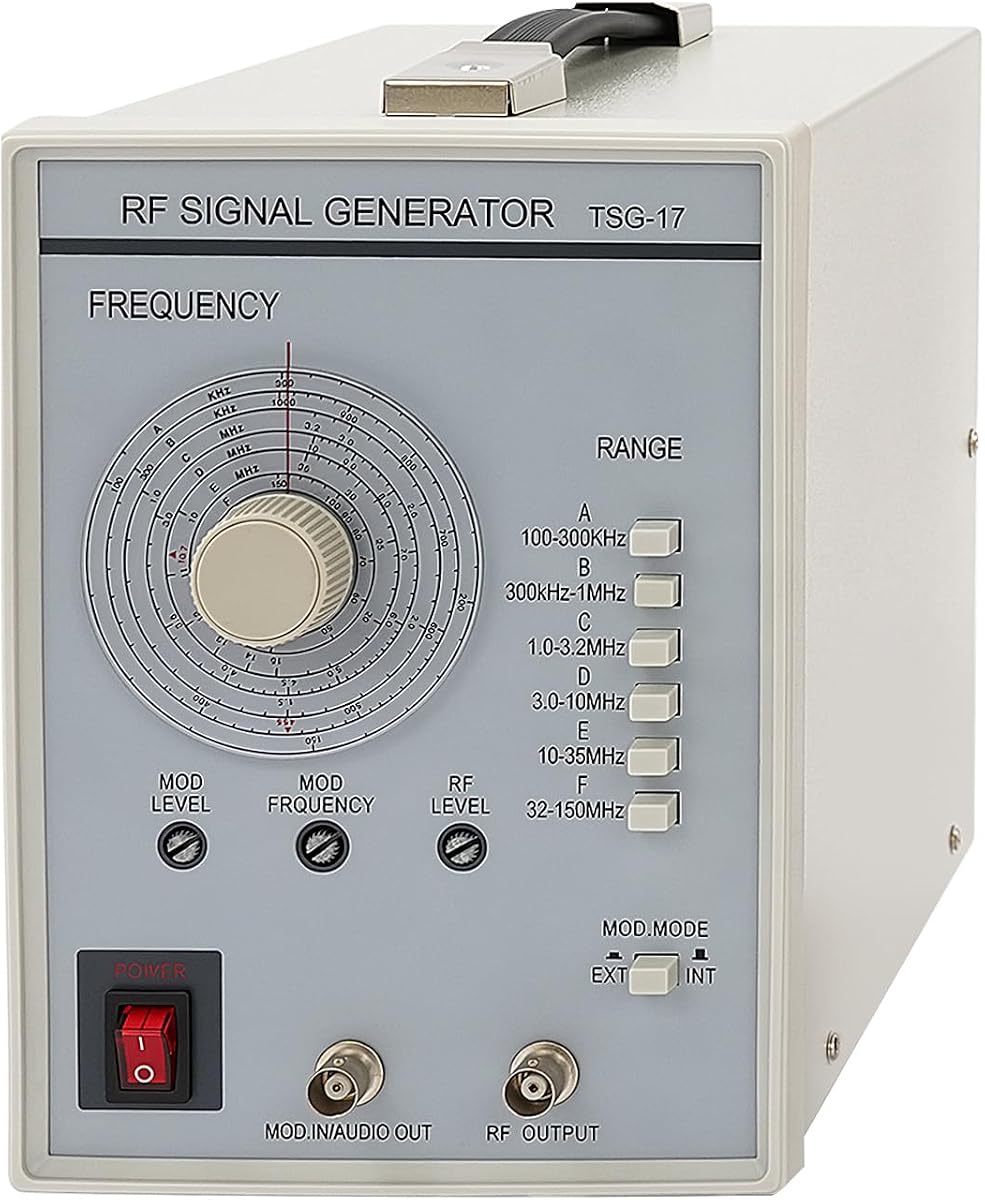
The TSG-17 offers a traditional approach to signal generation for commercial and household use. It provides high accuracy for those needing consistent RF output for calibration.
We may earn a commission when you buy through this link, at no additional cost to you.
Its 100kHz to 150MHz range covers most standard broadcast and communication bands. The external modulation input allows for additional signal processing flexibility.
Users have expressed dissatisfaction with reliability which is reflected in its rating. The design is functional but lacks modern convenience features like USB control.
This model might suit specific legacy equipment testing where exact frequency stability is required. Buyers should weigh the low rating against the specific needs of their project.
The device aims for high accuracy which is useful for calibration tasks where small errors matter.
Support for external signals from 50Hz to 20KHz enables custom modulation experiments.
We may earn a commission when you buy through this link, at no additional cost to you.
This Adjustable Signal Generator is designed for industrial control applications rather than RF testing. It provides precise current and voltage outputs for calibrating sensors and PLCs.
We may earn a commission when you buy through this link, at no additional cost to you.
The built-in lithium battery ensures you can work without access to mains power. PWM output adds flexibility for frequency related tasks in automation systems.
While it lacks RF capabilities, it is excellent for electrical calibration. The short circuit protection keeps your connected devices safe during testing.
Technicians working with process control will find this unit highly useful. Its focus on current loops makes it a specialized tool for specific industrial needs.
A capacity of 1500mAh provides up to five hours of use which is great for field service.
Short circuit protection ensures that accidental connections do not damage the generator or your test equipment.
We may earn a commission when you buy through this link, at no additional cost to you.
The Riiai 0-10V generator excels in simplicity and display clarity for voltage and current simulation. The 4-digit display allows for precise adjustments down to the hundredth of a volt.
We may earn a commission when you buy through this link, at no additional cost to you.
Its encoder knob makes it easy to set values quickly. The ability to switch between voltage and current modes on the same device adds significant versatility.
While not for waveform generation, it is perfect for control panel testing. The built-in battery ensures you can use it without tethering to a power outlet.
This tool is ideal for electricians and automation technicians. Its ease of use and reliable output make it a favorite for quick troubleshooting tasks.
The 4-digit display ensures you can see exact output values which is critical for calibration work.
Switching between voltage and current modes on the fly saves time when testing different circuit types.
We may earn a commission when you buy through this link, at no additional cost to you.
The Riiai SG003A offers comprehensive analog simulation for industrial maintenance at a budget-friendly price. Its TFT color screen provides clear visual feedback on current and voltage levels.
We may earn a commission when you buy through this link, at no additional cost to you.
With a 3000mAh battery it can work for up to 26 hours on a single charge. The programmable output allows for auto-rising or falling signals which aids in testing response times.
It supports multiple signal types including pulse signals for versatile testing. However the menu navigation may take time for new users to master fully.
This unit is perfect for field technicians needing a robust PLC simulator. Its battery life and feature set make it a strong value for money option.
The 3000mAh capacity ensures long shifts of testing without needing to find a power source.
Support for Hz pulse signals extends its use beyond simple analog testing tasks.
We may earn a commission when you buy through this link, at no additional cost to you.
The DROK 4-20mA generator is a straightforward tool for basic analog signal simulation. Its multifunctional design allows both current and voltage generation in one module.
We may earn a commission when you buy through this link, at no additional cost to you.
Adjusting the output via a potentiometer is simple and effective for quick tests. The compact size ensures it fits easily into a toolkit for mobile work.
While it lacks advanced digital features the basic functionality is reliable. It is perfect for quick checks on valves and panels without complex setups.
This unit is ideal for users who want simplicity over advanced features. Its reliability and ease of use make it a handy addition to any technician's bag.
The potentiometer control removes the need for menu navigation making it faster for quick adjustments.
Its small footprint makes it easy to carry and use in tight spaces or field sites.
We may earn a commission when you buy through this link, at no additional cost to you.
The SEESII Dual Channel generator brings premium precision to waveform generation with low distortion outputs. It is ideal for engineering R&D and university lab teaching.
We may earn a commission when you buy through this link, at no additional cost to you.
Its independent channels allow for phase difference adjustments which is great for differential circuit testing. The 14-bit resolution ensures signals are accurate and clean.
The package includes all necessary cables and adapters for immediate use. While it is pricier than budget options the quality and consistency justify the investment.
This unit is recommended for professional labs and serious enthusiasts. The combination of DDS technology and dual channels offers a high standard for testing.
Adjustable phase difference from 0 to 359.9 degrees allows precise circuit testing setups.
The high sampling rate ensures that signals remain true to their shape without added noise.
We may earn a commission when you buy through this link, at no additional cost to you.
Choosing the right Amfm Signal Generator depends on your specific testing needs and budget. This section outlines the key factors to consider when evaluating different models for purchase.
The frequency range determines the types of signals you can generate. Ensure the model covers the frequencies required for your work whether it is RF or audio.
Check the max frequency against your application requirements to avoid underpowered tools.
Look for models that support the specific modulation types you need such as AM, FM, or PM. This affects the versatility of the unit for different testing scenarios.
A broader range of modulation options increases the device's utility for varied tasks.
Dual channel generators allow you to compare signals or test differential circuits. Single channel models are simpler but less flexible for complex setups.
Choose dual channels if you need to synchronize or compare two signals at once.
A clear display helps you see parameters and waveforms easily. TFT LCD screens are preferred for their readability in various lighting conditions.
Ensure the display size is sufficient for comfortable viewing during long testing sessions.
If you need to use the generator on site, consider models with rechargeable batteries. Portability is key for field maintenance work.
Check battery life and charging options to ensure uninterrupted work.
USB connectivity allows for PC control and firmware updates which enhances flexibility. Look for models that integrate well with your workflow.
Connectivity can streamline automated testing and data logging tasks.
Sturdy construction ensures the unit withstands accidental bumps and drops. Metal casings are more durable than plastic for field work.
Investing in a robust build extends the lifespan of the device.
Balance the cost with the features offered. Budget models may lack precision while premium ones offer advanced capabilities for complex needs.
Determine your must-have features to find the best value within your budget.
Always start by connecting the power source or ensuring the battery is fully charged. This prevents interruptions during critical testing sessions.
Set the desired frequency and waveform parameters before connecting to the device under test. This ensures the signal matches your requirements.
Keep the unit clean and store it in a protective case when not in use. Avoid exposure to extreme temperatures to maintain component longevity.
An Amfm Signal Generator is used to produce electronic signals with specific frequencies and modulations. It is essential for testing radio circuits, calibration, and development work.
Yes, many modern models support USB connectivity. This allows for PC control, data logging, and easier setup management during complex tests.
For field work, a model with a built-in rechargeable battery is highly recommended. It ensures you can test without access to a power outlet.
A function generator typically covers lower frequencies suitable for audio, while an RF generator covers higher frequencies for wireless applications. Choose based on your required frequency range.
Use a soft, dry cloth to wipe the screen. Avoid harsh chemicals that could damage the coating or the sensitive electronic components inside.
Periodic calibration ensures accuracy remains high. Follow the manufacturer's schedule to check the output against a known standard.
Our top picks include the UNI-T UTG962E for overall performance and the Riiai SG003A for value. Each model offers unique benefits suited to different testing scenarios.
Prioritize frequency range and modulation options to match your specific needs. A device that fits your workflow will save time and improve accuracy.
Remember that prices and stock change often so verify current listings before buying. This ensures you secure the best deal for the chosen generator.